AI/ML
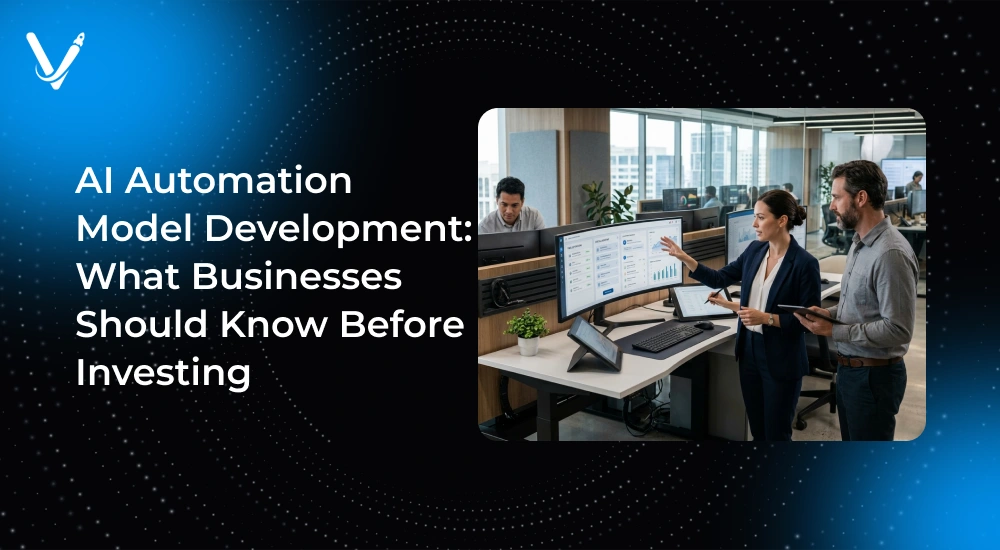
AI Automation Model Development: What Businesses Should Know Before Investing

 May 14, 2026







In Article:
AI Agent Workflow Automation in Software Development
Why Businesses Work With AI & Automation Developers
Businesses are under growing pressure to improve operational efficiency while managing rising costs, increasing customer expectations, and expanding workflow complexity.
Manual processes slow teams down. Repetitive administrative work consumes valuable time. Customer support demands continue increasing. Software teams are expected to deliver faster while maintaining operational quality.
This is one of the main reasons businesses are investing heavily in AI automation model development in 2026.
Organizations are no longer experimenting with isolated automation tools. They are building AI-driven operational systems that support workflow automation, customer interactions, internal reporting, software development operations, and enterprise scalability.
For many companies, AI automation has moved beyond productivity experimentation and become part of long-term operational strategy.
However, AI implementation is not only about adopting new software.
Businesses must evaluate:
before investing in AI automation systems.
This guide explains how AI automation model development works, where businesses are using AI automation successfully, and what organizations should consider before making large-scale AI investments.
AI automation model development refers to creating AI-powered systems that automate operational workflows, decision-making processes, and repetitive business tasks.
Unlike traditional rule-based automation, AI automation models can:
This allows businesses to automate more complex workflows than standard automation software can handle.
Traditional automation follows fixed instructions.
For example:
AI-driven automation works differently.
AI systems can:
This is where automated AI development becomes valuable for modern enterprises.
AI agents are increasingly used to automate business operations across departments.
Businesses now use:
These systems help organizations reduce repetitive workload while improving operational consistency.
AI workflow automation systems are also becoming more common in enterprise software environments where operational scale creates manual bottlenecks.
AI adoption is being driven by operational pressure rather than technology trends alone.
Businesses continue facing:
AI and automation development solutions help organizations scale operations without increasing administrative workload proportionally.
Many businesses still depend on:
These inefficiencies slow operational performance.
AI automation developer teams now focus heavily on workflow optimization because operational delays directly affect productivity and revenue.
Customer expectations continue increasing across industries.
Businesses must respond faster while maintaining service quality.
This is why AI agent development for customer service automation has become one of the fastest-growing enterprise AI segments.
Modern software teams manage:
AI automation is increasingly helping development teams manage operational complexity more efficiently.
Businesses are applying AI automation models across multiple operational environments.
Many organizations now deploy AI systems to:
This reduces support workload while improving response times.
Email management remains one of the most repetitive business tasks.
For example, a developer uses generative AI to automate email responses for:
This reduces administrative workload significantly.
AI automation systems now generate:
automatically from internal business data.
Businesses automate:
using AI workflow systems.
AI scheduling systems help businesses coordinate:
more efficiently.
Healthcare organizations increasingly use:
to reduce administrative pressure.
This is where ai clinical development automation and commercialization is becoming especially important for healthcare technology companies.
Modern development environments involve far more than writing code.
Teams also manage:
AI automation helps streamline these operational layers.
AI agent workflow automation for software development can support:
This reduces repetitive operational tasks for engineering teams.
AI systems are increasingly integrated into:
This improves operational visibility across development environments.
Independent software vendors are increasingly investing in isv development automation with ai to accelerate product delivery while controlling operational costs.
AI automation helps ISVs improve:
without expanding operational overhead aggressively.
Many businesses eventually realize that generic automation platforms do not fit complex operational requirements.
This is why organizations increasingly invest in custom AI automation development.
Custom AI systems are built around specific operational workflows.
This reduces friction between departments and systems.
Businesses automate repetitive tasks such as:
This improves employee productivity.
Custom automation systems scale more effectively because they align with operational infrastructure.
Custom AI systems support:
more effectively than generic automation tools.
AI systems can analyze:
to improve operational decision-making.
AI automation requires strategic planning.
Businesses that rush implementation often create operational complexity instead of solving it.
Organizations should identify:
before automation begins.
AI systems often need integration with:
Poor integration planning creates operational risks.
Businesses should evaluate whether their systems can support:
Operational teams must understand:
before deployment.
Many companies underestimate the operational knowledge required for implementation.
Even minimum viable machine learning knowledge for ai automation developers becomes important when businesses deploy AI-driven workflows at scale.
AI systems often process sensitive operational data.
Businesses must evaluate:
before implementation.
AI automation is not instant transformation.
Businesses should evaluate:
over long-term implementation cycles.
AI automation systems create strong operational advantages, but implementation challenges remain common.
AI systems depend heavily on operational data quality.
Poor data often reduces automation accuracy.
Not every workflow should be automated completely.
Businesses still require:
for complex decisions.
Generative AI systems can occasionally produce inaccurate outputs.
This creates risk in:
without proper oversight.
AI systems require:
to maintain performance.
Poorly designed AI systems often struggle when operational demand increases.
Scalability planning remains essential.
Healthcare organizations are increasingly investing in AI automation systems to reduce administrative pressure and improve operational coordination.
Healthcare providers now automate:
This reduces repetitive administrative workload.
Pharmaceutical and healthcare technology companies also use AI automation for:
Healthcare AI systems require:
This is why clinical automation ai developer documentation and tools remain important for regulated industries.
Enterprise AI implementation requires operational expertise beyond software deployment.
This is why businesses increasingly work with experienced AI & automation developers.
Experienced AI teams understand:
more effectively than general software teams.
Large-scale AI systems require scalable infrastructure planning.
This includes:
Many organizations now work with consultancies ai app development digital transformation process automation specialists to manage operational modernization more strategically.
This reduces deployment risks while improving scalability planning.
AI automation systems are evolving rapidly.
Businesses are moving toward:
Future AI development will likely focus heavily on operational coordination rather than isolated automation tasks.
Organizations that invest strategically in scalable AI infrastructure today will likely adapt more effectively as enterprise AI systems continue maturing.
Businesses are increasingly investing in AI automation model development because operational complexity continues growing across industries.
AI automation helps organizations:
However, successful AI implementation requires:
Businesses that approach automation strategically are more likely to achieve sustainable operational improvements.
Companies looking to modernize operations through AI automation development, enterprise workflow automation, AI integration systems, and custom AI solutions can work with Vasundhara Infotech to build scalable AI-powered business systems tailored to enterprise operational requirements.
Copyright © 2026 Vasundhara Infotech LLP. All Rights Reserved.