


trending blog
Reflection AI’s SpaceX Deal Paves the Way for Open-Weight Models

 Jun 25, 2026





Open-weight AI models are no longer the underdog. In early 2025, an open-weight model from DeepSeek shook the whole industry and showed that open models can rival closed ones. Since then, the race to build powerful open-weight ai models has only sped up.
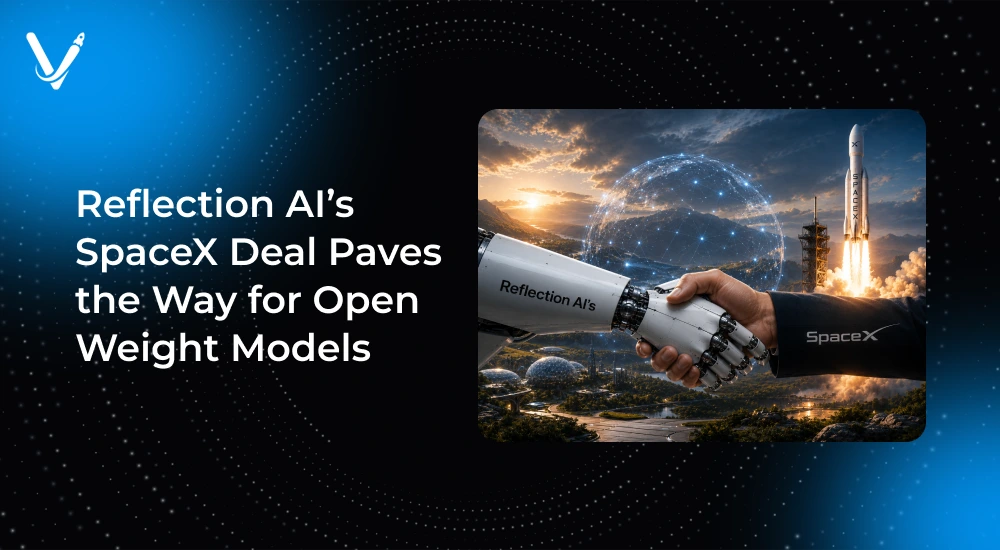
One of the names in that race is Reflection AI, an open-source AI startup building frontier models. The company is now in the news for a reported compute partnership tied to SpaceX. A deal like this matters for one big reason. Training top open-weight models needs huge amounts of compute, and compute is the hardest thing to get.
In this guide, we explain what open-weight models are, why this kind of AI compute partnership matters, and what it all means for your business. If you want help building your own models, our AI development services team can guide you.
Open models have closed much of the gap with closed ones. Stanford’s AI Index reports that the performance gap between top open and closed models shrank sharply over the past year.
An open-weight AI model is one where the trained weights are shared. Weights are the core of a model. They hold what the model has learned. When a company shares them, you can download the model, run it on your own servers, and tune it for your needs.
This is different from a closed model. With a closed model, the weights stay hidden. You can only use it through the vendor’s service. You do not control it, and your data flows through their systems.
Here is the simple difference:
• Open-weight: you can download and run the model yourself
• Closed: you can only use it through a vendor
Open-weight models give you more control. That is why open-weight AI model development has become a major trend for both startups and large firms.
Reflection AI raised one of the largest early rounds in AI, reportedly around 2 billion dollars, to build open frontier models. A compute partnership is the next piece of that puzzle.
To be clear, the exact terms of the reported SpaceX deal are still coming to light, so check primary sources for the latest details. But the broad idea is easy to grasp. To train large open-weight models, you need massive compute. That means thousands of high-end chips, plus power and infrastructure to run them.
A big AI compute partnership solves that problem. It gives a startup the scale it needs to train frontier models. Without it, even a well-funded open-source AI startup can stall.
This is why the deal draws so much interest. If an open-weight player secures serious compute, it can train models that rival closed giants. That shifts the balance of power in AI, and it gives businesses more open options to choose from.
Training a single frontier model can cost tens or even hundreds of millions of dollars in compute. That cost is the wall most teams hit.
Building a top model is not just about smart code. It is about raw power. You need AI infrastructure for model training at a huge scale.
That includes:
• Thousands of high-end GPU or AI chips
• Fast networking to link them together
• Large amounts of power and cooling
• Storage for huge training datasets
Few firms can afford to build all of this alone. That is why scalable AI model training often depends on partnerships. One side brings the model skill. The other brings the compute and infrastructure.
For open-weight models, this matters even more. Open players give their weights away, so they cannot charge the same way closed firms do. They need low-cost, large-scale compute to make the math work. A strong compute deal can be the difference between leading and falling behind.
Meta says its open Llama models have been downloaded hundreds of millions of times. That scale shows how much businesses want open options.
For a CEO or CTO, open-weight models open up real choices. Here is why enterprise open-weight AI development is growing so fast.
You run the model on your own servers. You decide how it works and where it lives. You are not locked into one vendor.
Your data can stay in-house. It does not have to flow to an outside service. For firms with strict data rules, this is a big deal.
You do not pay per use forever. Once you run your own model, heavy use can cost far less over time. This helps high-volume teams the most.
You can tune the model on your own data. This makes it fit your work far better than a generic tool. Custom AI model development turns a general model into your own edge.
Open-weight models are not right for every team. They need skill to run well. But for many firms, they offer a path to strong, private, low-cost AI.
About three in four developers now use or plan to use AI tools, per Stack Overflow. Many now weigh open against closed models for their stack. Here is a quick side-by-side.

More control means more responsibility. When you run your own model, AI compliance falls on you.
Open-weight models are powerful, but they bring duties. You must use them in a safe, legal way. Here is what to watch.
• Licenses: check the model’s license before you use it for business
• Data: keep private and customer data safe during training and use
• Accuracy: review output, since models can be wrong but sound right
• Security: protect the model and its data from misuse
• Rules: make sure your use meets your industry’s laws
Here are simple steps to stay safe:
1. Read and follow the model’s license terms
2. Keep sensitive data secure at every step
3. Review AI output before you ship it
4. Set clear rules for staff on safe use
5. Keep a human in the loop for key calls
One last point. Open-weight does not mean rules-free. If anything, it asks more of you. A good partner can help you set up your models in a safe, compliant way from the start.
You do not need to train a model from scratch to benefit. Most firms start by tuning an existing open model.
Here is a simple path to put open-weight models to work:
6. Pick a clear use case, like support, search, or content
7. Choose a strong open-weight model with a fair license
8. Tune it on your own data for a better fit
9. Set up safe, scalable infrastructure to run it
10. Test, measure, and improve over time
This is where a build partner helps most. From custom AI model development to enterprise AI solutions, the right team handles the hard parts. See how we approach custom AI development, or how we build AI chatbots for real business needs.
Reflection AI’s reported SpaceX deal is more than one headline. It points to a bigger shift. Open-weight models are getting the compute they need to compete with closed giants.
Rather than locking AI behind one vendor, open-weight models give businesses more control and more choice.
For enterprises, the main benefits include:
• More control over your AI stack
• Better data privacy
• Lower cost at scale
• Full customization on your own data
• Less vendor lock-in
At the same time, open-weight AI must be used with care. Licensing, data security, and clear compliance rules stay essential parts of any rollout.
Open-weight models are quickly becoming a core part of the AI world. Firms that learn to use them well may gain a real edge in the years ahead.
Businesses exploring open-weight AI can benefit from custom enterprise solutions. At Vasundhara Infotech, we help organizations build, tune, and deploy scalable AI models and enterprise-grade AI solutions designed for real business needs.