


AI/ML
Generative AI vs Traditional Chatbots in Healthcare: Which Delivers Better Patient Engagement and ROI?

 Jul 16, 2026





A patient asks your chatbot, 'Can I take this medication with my blood pressure pills?' An old rule-based bot has one reply: 'Please contact your provider.' A generative AI assistant can pull the right guidance and give a real answer.
That gap is why hospitals are rethinking their chatbots.
AI use in healthcare is growing fast. Providers are spending on patient engagement, scheduling, support, and digital health, across operations, patient support, and clinical workflows.
Patient engagement is now a top priority. People expect quick, clear answers, the same way they get from a bank app or an airline. A phone queue does not cut it anymore.
For years, the answer was a rule-based chatbot. It followed a script. Now generative AI can hold a real conversation. Teams weighing the two often start by talking to an AI development services partner about which one fits their budget and their patients.
This guide compares both. It is written for hospitals, clinics, healthcare startups, and healthcare SaaS teams who have to pick one and defend the choice to a board.
A traditional healthcare chatbot follows fixed rules. It works like a flowchart. The patient picks an option, the bot gives the matching reply, and so on down the tree.
There is no real understanding. If the patient types something the script did not plan for, the bot gets stuck or repeats itself.
Developers map out every question and every answer in advance. This is a decision tree with predefined responses. It is reliable for narrow tasks and predictable by design.
• Appointment scheduling through a set list of options.
• FAQ automation for hours, directions, and services.
• Insurance queries with standard, repeatable answers.
• Basic patient support that routes the hard cases to staff.
For simple, high-volume tasks, traditional healthcare chatbots still do the job. A good AI chatbot for healthcare providers built this way is cheap to run and easy to control. The limit shows the moment a patient asks something off-script.
Generative AI creates a fresh answer for each question instead of reading from a script. It runs on large language models, or LLMs, trained on huge amounts of text. IBM describes generative AI as technology that produces original content in response to a request, rather than picking from fixed options.
In healthcare, that means the assistant can understand a full question, remember the earlier part of the chat, and reply in plain language.
It is context-aware. It follows the thread of a conversation. It personalizes the reply to the person, not the script. And it handles questions no one wrote a rule for.
Cloud vendors have made this easier to build. AWS and Google Cloud both offer managed tools for generative AI, which is why an AI healthcare assistant is no longer only for big hospitals with large budgets.
The catch is that a raw model can be wrong and still sound sure of itself. That is why serious builds pair the model with trusted medical sources and human review, work that generative AI development services handle as standard.
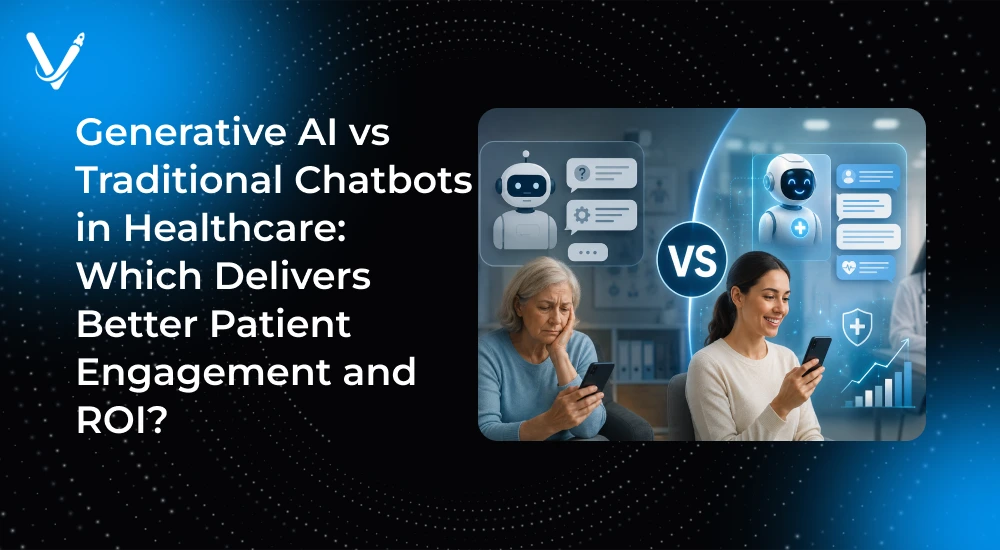
Both answer patient questions. They do it in very different ways.

The pattern is clear. Traditional bots are fixed and cheap. Generative AI is flexible and smarter, but it needs more care around accuracy and cost.
A scripted bot gives the same answer to everyone. A generative assistant reads the actual question and responds to it. Patients notice the difference right away.
A patient engagement chatbot built on generative AI can adjust to the person's history, language, and situation. A rule-based bot treats every patient the same.
People stay in a conversation that feels like it understands them. They drop out of one that keeps saying 'I did not get that.' Engagement is really about not losing the patient halfway.
An AI healthcare assistant can answer in many languages and explain things in plain words. That reaches patients a rigid English-only script would lose.
Both run 24/7. But generative AI can actually resolve more questions at 2 a.m. instead of just parking them until office hours.
For engagement, generative AI wins in most cases. It keeps more patients in the conversation and sends fewer of them to a phone queue.
Return on investment is where the choice gets real. Look past the sticker price to the full three-year cost and value.

A traditional bot is cheaper to start and fine when the task never changes. Its weakness is that every new question means new code.
Generative AI costs more upfront and carries a monthly run cost. It pays back through volume, because it handles far more questions without a human and keeps improving.
A simple rule: if your questions are few and fixed, a traditional bot wins on ROI. If they are varied and growing, generative AI pulls ahead over time.
The real payback comes from healthcare workflow automation, not just chat. When the assistant plugs into your systems, it stops answering and starts doing.
Booking, rescheduling, and cancellations handled in real time, without a call to the front desk.
Forms, history, and symptom details collected before the visit, so the clinician starts informed.
Reminders for visits, medication, and tests, sent on time and tuned to the patient.
Handoffs routed to the right team with the full chat history attached.
Staff get quick answers about policies and protocols, pulled from approved documents.
Insurance checks, billing questions, and repeat queries handled without staff time.
Automating these tasks is where hospitals see the hours and the savings add up month after month.
Any healthcare AI touches sensitive data, so compliance is not optional. Build it in from the start.
Any vendor that handles protected health information needs a signed Business Associate Agreement. That includes your model provider.
Collect the minimum data needed. Know where it lives. Ask whether the vendor trains models on your patients' data, and get the answer in writing.
Set clear rules on what data the assistant can see, how long it is kept, and who can access it.
Keep a clinician in the loop for anything close to medical advice. The assistant should hand off, not guess.
Log every question, retrieved source, and answer. If a regulator asks what the bot told a patient, you need a clear record.
Tell patients they are talking to AI. Give them an easy path to a human. As adoption grows, AI safety and governance stay front of mind, so manage privacy and safety carefully at every step.
Traditional chatbots are still the smart pick in plenty of cases.
• Small clinics with simple, repeat questions and a tight budget.
• Limited budgets where a low upfront cost matters most.
• Simple workflows like a fixed FAQ or a basic booking flow.
• Basic patient support that mostly routes people to the right desk.
If your questions rarely change and the volume is manageable, a rule-based bot does the job at a lower cost. There is no need to pay for power you will not use.
Generative AI earns its cost when the interactions get complex.
• Hospitals with high call volumes and a wide range of questions.
• Healthcare SaaS platforms that sell the assistant as a product feature.
• Telehealth providers needing rich pre-visit and post-visit support.
• Enterprise healthcare organizations serving many patient types.
• Any setting with complex, varied patient interactions.
In these cases, the flexibility pays for itself. When the assistant also has to run workflows and connect to hospital systems, teams usually pair it with custom software development so the whole thing works as one product, not a bolt-on.
Assistants that know a patient's history and stay with them across a whole care journey, not just one chat.
Phone lines answered by an assistant that books appointments and escalates urgent calls to staff.
Systems that decide what to do, act on it, and check their own work before replying. They book the slot instead of just talking about it.
Support shaped by the patient's own care plan, pulled live from the record rather than a generic FAQ.
Voice, chat, and workflow tools built on one backend, sharing the same data and rules. Adoption of these assistants and patient support systems keeps growing.
None of this is far off. The pieces exist now. Governance and data quality decide who benefits first.
Traditional chatbots and generative AI solve different problems. A rule-based bot is cheap, reliable, and fine for simple, fixed tasks. Generative AI is flexible, personal, and far better at complex, changing conversations.
On patient engagement, generative AI usually wins. It keeps more people in the conversation and reaches patients a rigid script would lose.
On ROI, the answer depends on your questions. Few and fixed favors traditional. Varied and growing favors generative AI over time.
Compliance decides more than most buyers expect. HIPAA, privacy, audit trails, and human oversight belong in the plan from week one.
Healthcare organizations evaluating AI chatbot solutions should focus on patient experience, compliance, scalability, and long-term business value rather than choosing technology based only on upfront costs.
If you are weighing both options for your hospital, clinic, or health platform, our team can help you map the use cases and the compliance work before a line of code is written.