AI/ML
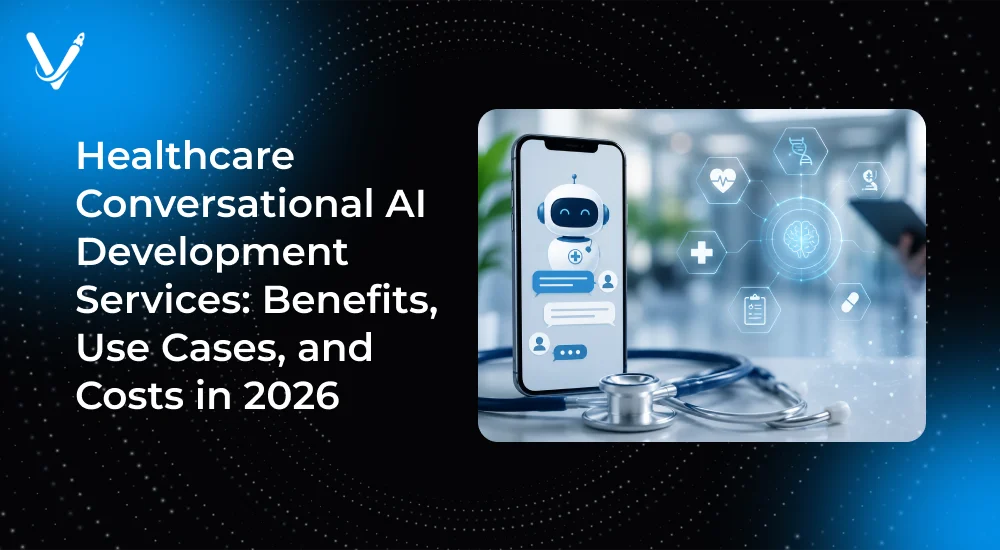
Healthcare Conversational AI Development Services: Benefits, Use Cases, and Costs in 2026

 Jul 1, 2026







In Article:
Why Healthcare Organizations Are Investing in Conversational AI
Benefits of Healthcare Conversational AI Development Services
Key Features of Modern Healthcare Conversational AI Platforms
How to Choose a Healthcare Conversational AI Development Company
The pressure behind this shift is real. The country faces a growing staffing crunch. The Association of American Medical Colleges projects a shortage of up to 86,000 physicians by 2036. Nursing groups report similar strain. Many clinicians feel worn down, and national surveys have found that close to half of physicians report signs of burnout. Administrative work adds to that load.
At the same time, patient expectations keep rising. People now want the same fast, always-on service they get from banks and retailers. They expect to book a visit at midnight, check a lab result on a phone, and get an answer in seconds. Money is following that demand. Market researchers expect the healthcare conversational AI and chatbot space to grow at roughly 20 to 25 percent per year through the early 2030s, reaching several billion dollars in yearly value. For healthcare executives, CIOs, and IT leaders, the real question is how to build these tools well, keep them safe, and make them pay off. This guide covers the benefits, the top use cases, the true costs in 2026, and how to pick the right development partner.
Quick answer: Healthcare conversational AI is software that lets patients talk to a health system in plain language. It works through chat or voice. It uses NLP, machine learning, and generative AI to read a request and act on it, such as booking a visit.
Instead of clicking through menus, a patient types or speaks a request and gets a clear reply. The system reads the meaning behind the words and responds in a natural way. Some tools stay text based. Others use voice, so a patient can call a phone line and speak with an assistant that sounds human. Several building blocks make this work.
• Natural Language Processing (NLP): the engine that breaks down what a patient types or says, handling spelling slips and long questions.
• Natural Language Understanding (NLU): a deeper layer that works out intent, such as telling a booking request apart from a report of chest pain.
• Machine Learning (ML): the system learns from past chats and gets better at reading requests over time.
• Generative AI: newer models write full, fluent replies rather than pick from a fixed script, which covers a wider range of questions.
• Voice AI: speech tools turn spoken words into text and back again, powering phone lines that answer calls and confirm visits.
These three terms are not the same. A traditional chatbot follows a fixed script. Conversational AI understands free language. An AI agent goes further and takes action on its own.
| Feature | Traditional Chatbot | Conversational AI | AI Agent |
| Understands free language | No, menu based | Yes | Yes |
| Handles voice | Rare | Often | Yes |
| Learns over time | No | Yes | Yes |
| Takes action in systems | Limited | Some | Full, multi-step |
| Generative replies | No | Often | Yes |
| Best fit | Simple FAQs | Patient chat and support | Complex workflows |
Quick answer: Healthcare groups invest in conversational AI for a few clear reasons. It eases admin work, cuts costs, and reduces staff burnout. It also boosts patient engagement and meets the demand for fast, 24/7 care.
Front desk teams spend hours on repeat tasks. They confirm visits, answer the same questions, and chase paperwork. Studies of United States healthcare spending suggest administrative work eats up close to a quarter of the total. Conversational AI takes over the routine parts so staff can focus on patients who need real help.
Clinicians are tired. Long hours and heavy screen time push many toward burnout, and some leave the field. National surveys put physician burnout near half in recent years. When AI handles intake notes, reminders, and simple questions, it lifts weight off the care team and helps keep good people in their jobs.
Labor is the biggest line item in most health systems. Wages keep climbing while margins stay thin. A well built assistant handles thousands of chats at once for a fraction of the cost of adding more staff to the phones.
Many patients drift away from care between visits. They forget refills or skip follow-ups. A patient engagement AI checks in, sends nudges, and answers worries in the moment, which keeps people on track with their care plans.
Health worries do not keep office hours. A parent with a sick child at 2 a.m. wants help now. Conversational AI healthcare solutions stay awake around the clock. They give safe guidance, book urgent slots, and flag red flag symptoms for fast human review.
Quick answer: The main benefits are easy to see. Patients get 24/7 support and shorter wait times. Staff carry a lighter load and get more done. The clinic sees lower costs and happier patients.
• 24/7 patient support: patients get answers at any hour, with no hold music and no voicemail.
• Reduced wait times: common requests get handled in seconds instead of long phone queues.
• Better patient experience: fast, clear replies build trust and cut frustration.
• Lower costs: automated intake and scheduling reduce the load on front desk teams.
• Staff productivity: staff spend time on care and complex cases, not repeat questions.
• Better appointment management: reminders and easy rescheduling cut costly no-shows.
• Personalized communication: the system tailors messages to each patient based on their history.
• Better care coordination: chat, voice, and web stay in sync, so nothing falls through the cracks.
| Task | Manual Process | With Conversational AI |
| Booking a visit | 5 to 10 minute phone call | Under a minute by chat or voice |
| After-hours questions | Voicemail, next-day reply | Instant answer any time |
| Appointment reminders | Staff call each patient | Automatic, at scale |
| Patient intake forms | Paper or manual entry | Guided digital intake |
| Language support | Limited to on-site staff | Many languages built in |
| Cost to scale | Hire more staff | Software handles the surge |
Quick answer: The top use cases cover the whole patient journey. They include scheduling, intake, symptom checks, triage, and telehealth. They also cover reminders, follow-up, insurance, billing, education, chronic care, and voice call automation.
Problem: Phone lines get jammed and patients hang up before booking. Staff play phone tag for weeks.
AI solution: The AI books, moves, and cancels visits through chat or voice. It checks open slots in real time and confirms on the spot.
Business impact: More booked visits, fewer dropped calls, and a lighter load on the front desk.
Problem: New patients fill long paper forms in the waiting room, which slows the clinic and creates errors.
AI solution: A conversational assistant guides patients through intake before they arrive and sends the data straight to the record.
Business impact: Shorter wait times, cleaner data, and faster room turnover.
Problem: Patients are unsure if a symptom needs a visit, so they either panic or wait too long.
AI solution: The AI asks safe, structured questions and gives general guidance on what to do next. It never replaces a clinician.
Business impact: Fewer needless visits and faster help for people who truly need it.
Problem: Urgent cases can get stuck behind routine calls, which risks patient safety.
AI solution: The system spots red flag symptoms and pushes those cases to a nurse or doctor right away.
Business impact: Safer care, better use of clinical time, and clear priority for serious cases.
Problem: Patients struggle to join video visits and often need tech help minutes before an appointment.
AI solution: A virtual assistant walks patients through setup, checks their device, and answers pre-visit questions.
Business impact: Fewer failed video visits and less stress for both patients and staff.
Problem: Many patients forget doses or stop taking medicine, which harms outcomes and drives up costs.
AI solution: The AI sends timed reminders, answers questions about the drug, and flags missed doses for the care team.
Business impact: Better medication adherence and fewer avoidable hospital returns.
Problem: After leaving the hospital, patients may miss warning signs and end up readmitted.
AI solution: An assistant checks in on a schedule, asks about recovery, and escalates concerns to a nurse when needed.
Business impact: Lower readmission rates, which protects both patients and hospital revenue.
Problem: Staff spend hours on the phone confirming coverage, and patients face surprise bills.
AI solution: The AI collects insurance details up front and helps confirm coverage and benefits before the visit.
Business impact: Faster check-in, fewer billing disputes, and cleaner claims.
Problem: Medical bills confuse patients, which leads to unpaid balances and frustrated calls.
AI solution: A billing assistant explains charges in plain language, sets up payment plans, and answers common questions.
Business impact: Higher on-time payments and fewer calls to the billing office.
Problem: Patients leave visits with questions and turn to unreliable web sources.
AI solution: The AI shares clear, approved information about conditions, procedures, and aftercare, tuned to each patient.
Business impact: Better informed patients, stronger trust, and improved outcomes.
Problem: People with long term conditions need steady support that busy clinics cannot always give.
AI solution: The assistant tracks symptoms, prompts healthy habits, and alerts the care team when readings drift out of range.
Business impact: Steadier control of chronic conditions and fewer emergency visits.
Problem: Call centers are costly and callers wait on hold, which hurts satisfaction.
AI solution: Voice AI answers calls, handles routine requests end to end, and hands off complex calls to a human with full context.
Business impact: Lower call center costs, shorter hold times, and happier callers.
Quick answer: A patient message moves through a chat or voice interface to an NLP engine and an AI model. The system checks the EHR and loops in staff for urgent cases. Then it sends a clear reply back, all within seconds.
1. Patient: the patient starts a chat or call with a question, such as booking a visit or asking about a symptom.
2. Conversational AI interface: the message enters through a web widget, mobile app, or phone line.
3. NLP engine: this layer reads the words and works out what the patient means.
4. AI model: the model decides the best response and, when set up as an agent, the right action to take.
5. EHR integration: the system checks or updates the electronic health record, such as open slots or patient history.
6. Healthcare staff: for urgent or complex cases, the request is passed to a nurse, doctor, or agent with full context.
7. Patient response: the patient gets a clear, correct answer or a confirmed action, all within seconds
Key Features of Modern Healthcare Conversational AI Platforms
Quick answer: Modern healthcare platforms share a core set of features. These include HIPAA compliance, EHR integration, voice AI, and many languages. They also add analytics, omnichannel chat, generative AI, human handoff, and strong encryption.
Here is the Markdown table converted from the image:
| Feature | Basic Chatbot | Healthcare Conversational AI Platform |
| HIPAA compliance | Rare | Built in by default |
| EHR integration | No | Yes, Epic, Cerner, and others |
| Voice AI | No | Yes |
| Multilingual support | Limited | Many languages |
| Analytics dashboard | Basic | Detailed insights |
| Omnichannel | Single channel | Chat, voice, web, SMS |
| Generative AI responses | No | Yes, within safe limits |
| Human escalation | Manual | Smooth handoff with context |
| Security and encryption | Basic | Encrypted in transit and at rest |
Each feature earns its place. HIPAA compliance and encryption keep patient data safe. EHR integration keeps records in one place. Voice AI and multilingual support widen access. Human escalation makes sure that any case needing real judgment reaches a person fast.
Quick answer: Healthcare conversational AI costs range widely in 2026. A basic bot starts near $15,000. An enterprise system can pass $300,000. The final price depends on scope, integrations, and compliance needs.
Cost is often the first question from hospital administrators and technology leaders. The honest answer is that it depends. The ranges below reflect common industry figures for United States projects in 2026. Treat them as planning estimates, not fixed quotes. Every project should be scoped in detail.
| Solution Tier | Typical Cost Range | Best For | Timeline |
| Basic solution | $15,000 to $40,000 | Single clinic, FAQ and booking bot | 6 to 10 weeks |
| Advanced solution | $40,000 to $120,000 | Multi-clinic, EHR integration, voice AI | 3 to 6 months |
| Enterprise solution | $120,000 to $300,000+ | Hospital network, full agent workflows | 6 to 12 months |
| Cost Component | Basic | Advanced | Enterprise |
| Development | $8k to $20k | $20k to $55k | $55k to $140k |
| Integrations | $2k to $6k | $8k to $30k | $30k to $80k |
| Compliance (HIPAA) | $2k to $6k | $6k to $18k | $18k to $45k |
| Maintenance (yearly) | 15% to 25% of build | 15% to 25% of build | 15% to 25% of build |
| Support (yearly) | Basic tier | Priority tier | Dedicated team |
Quick answer: A few clear challenges stand out. They include HIPAA rules, data privacy, and AI accuracy. Hallucinations, regulations, slow staff buy-in, and ethics also matter. Careful design and human review keep each one in check.
Any tool that touches patient data must meet HIPAA rules. That shapes how data is stored, shared, and logged. Skipping this step risks fines and lost trust.
Patients need to know their data is safe. Clear consent, tight access controls, and honest privacy notices are a must.
Generative models can sometimes produce wrong or made-up answers, known as hallucinations. In healthcare this is a serious risk. Good systems limit the model to approved information, avoid clinical guesses, and pass hard cases to a human. Guardrails and human review keep answers safe.
Rules go beyond HIPAA. State laws, FDA guidance on some tools, and payer rules can all apply. A strong partner tracks these and builds to meet them.
Staff and patients may resist a new tool. Training, clear value, and a simple design help win them over.
Fairness matters. The system should serve all patient groups well and avoid bias. Human oversight keeps care safe and just.
Quick answer: Six trends will shape the next few years. Expect stronger generative AI, AI agents, and natural voice AI. Also expect agentic workflows, predictive care, and personalized patient chat. The market is growing 20 to 25 percent per year.
Newer models write more natural replies and handle a wider range of questions, which cuts the need for rigid scripts.
Assistants are moving from answering questions to taking action. They will book, reschedule, and update records on their own within safe limits.
Natural sounding phone assistants will handle a large share of routine calls in clinics and call centers.
Several AI agents will work together across tasks, from intake to follow up, with staff stepping in only when needed.
By reading trends in patient data, these tools will flag risks early and prompt outreach before a small issue becomes a crisis.
Communication will grow more tailored, shaped by each patient's history, language, and preferences, which lifts engagement and outcomes.
Quick answer: Pick a partner with proven healthcare work. They should have deep HIPAA skill and real EHR experience. Look for strong security, clear scalability, wide AI skill, and solid support.
Use this executive checklist when you compare a healthcare AI development company.
• Healthcare experience: real projects with clinics or hospitals, not just general software work.
• HIPAA expertise: deep knowledge of United States privacy rules, built in by default.
• EHR integration: proven work with Epic, Cerner, and other systems you use.
• Security: encryption, access controls, and a clear plan for audits.
• Scalability: the tool must handle growth in users, channels, and locations without breaking.
• AI capabilities: strength in NLP, generative AI, and voice, not just simple chatbots.
• Enterprise support: a partner who stays on after launch for updates, tuning, and support.
United States healthcare is under real strain. Staff are stretched, costs keep climbing, and patients expect fast, always-on service. Healthcare conversational AI development services offer a practical way forward. They take routine work off the care team, give patients quick answers at any hour, and keep data safe within HIPAA rules.
The business value is clear. These tools cut no-shows, lower administrative costs, lift staff productivity, and improve the patient experience. For implementation, success depends on a clear plan, safe design, clean EHR integration, and a partner who knows healthcare from the inside. Teams should start with a focused use case, prove the value, then scale.
The outlook is strong. With generative AI, voice, and agentic workflows advancing fast and the market growing 20 to 25 percent per year, conversational AI is moving from a nice extra to a core part of how care is delivered. Organizations that build well now will be ready for what comes next
Copyright © 2026 Vasundhara Infotech LLP. All Rights Reserved.