


trending blog
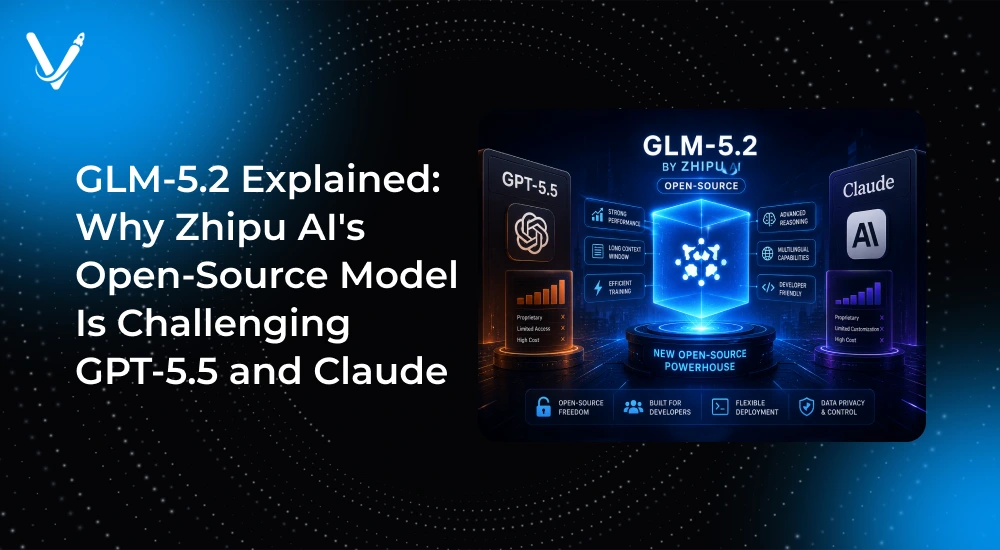
GLM-5.2 Explained: Why Zhipu AI's Open-Source Model Is Challenging GPT-5.5 and Claude

 Jul 1, 2026





For years, the best AI models were locked behind a paid API. You could rent them, but you could not own them. In June 2026 that changed. Chinese lab Z.ai, formerly known as Zhipu AI, shipped GLM-5.2, a 753-billion-parameter open-weights model built for coding and autonomous agents. It arrived with a 1-million-token context window and a permissive MIT license, which means anyone can download it, run it, and change it. That combination is why developers cannot stop talking about it.
The timing made the story bigger. In the same window, the US government moved to restrict foreign access to Anthropic's most advanced models, and those models were pulled offline for many users. On the day access to top closed models tightened, Z.ai handed the world a free download that scores near the frontier. For teams outside the US, GLM-5.2 became the most capable openly licensed model they could actually use.
Enterprises are paying attention for a plain reason: cost and control. GLM-5.2 runs at roughly one-sixth the price of top closed models, and its open weights let regulated firms keep data in-house. Independent testers at Artificial Analysis ranked it the top open-weight model on their Intelligence Index. This guide explains what GLM-5.2 is, how it performs, what it costs, and how it stacks up against GPT-5.5 and Claude, so developers, CTOs, and technology leaders can decide if it fits their stack.
GLM stands for General Language Model. It is the flagship series from Z.ai, a Beijing lab spun out of Tsinghua University in 2019. GLM-5.2 is the newest model in that line. What sets it apart is not one feature but a mix that few models offer together.
Open-weight means the model's trained weights are public. You can download GLM-5.2, run it on your own servers, and fine-tune it for your needs. The MIT license goes further than most. It puts almost no limits on use, including commercial use. This is different from closed models like GPT-5.5 or Claude, where you can only reach the model through a vendor API. With GLM-5.2, self-hosting is a real option.
Z.ai did not build GLM-5.2 as a chat toy. It is tuned for software engineering, multi-step reasoning, and tool use. Long-horizon tasks are jobs that take many steps over a long span, like fixing a bug that touches ten files or planning a full feature. Agentic workflows are tasks where the model acts on its own, calls tools, and checks its work. GLM-5.2 is made for exactly this kind of work, which is why it fits AI agents and coding tools so well.
Under the hood, it uses a Mixture-of-Experts design with about 753 billion total parameters and roughly 40 billion active per token. That sparse setup keeps it powerful while holding down the cost of running it.

Benchmarks are tests that measure how well a model performs on set tasks. GLM-5.2's results are strong, especially on coding and agent work. On SWE-bench Pro, which uses real open-source code, it scored 62.1, beating GPT-5.5 at 58.6. On FrontierSWE, a test of long-horizon task completion, it hit 74.4 percent, ahead of GPT-5.5 and close to Claude Opus 4.8.
On the broader Artificial Analysis Intelligence Index, GLM-5.2 scored 51, the top spot among open-weight models, ahead of DeepSeek V4 Pro and Kimi K2.6. On human-rated leaderboards it also ranked first on the Design Arena and near the top on Code Arena. The table below shows how it lines up on the coding tests that matter most.

The read is simple. GLM-5.2 leads open models and beats GPT-5.5 on key coding tests. Claude Opus 4.8 still holds a lead on the hardest coding sets. But GLM-5.2 gets close enough that, for many teams, the price and openness tip the scale.
In short: GLM-5.2 matches or beats GPT-5.5 on several coding benchmarks and trails Claude Opus 4.8 by a few points on the hardest sets. Its edge is price and openness: it costs roughly one-sixth as much and ships as a free, self-hostable download.
GPT-5.5 is OpenAI's frontier model, released in April 2026. It is strong, agent-focused, and widely used. Here is how the two compare on the points that drive a buying choice.

On raw coding, GLM-5.2 has a slight edge. On price the gap is large. GPT-5.5 lists at about $5 per million input tokens and $30 per million output, while GLM-5.2 sits far below that. GPT-5.5 still wins on ecosystem, tooling, and hosted reliability. If you want a proven, fully managed model, GPT-5.5 is a safe pick. If you want low cost and control, GLM-5.2 is hard to beat.
Claude Opus 4.8 from Anthropic is one of the strongest models for coding and agent work. It leads SWE-bench Pro at 69.2 and tops the Artificial Analysis Intelligence Index. GLM-5.2 does not quite reach it on the hardest coding sets, but the comparison is closer than the price gap suggests.

Claude Opus 4.8 is the stronger model on the hardest coding and reasoning tasks, with a mature enterprise ecosystem behind it. GLM-5.2 wins on cost and openness, and it is the model many teams reach for when they want to self-host or cut their bill. For high-stakes autonomous coding, Claude leads. For high-volume work where cost dominates, GLM-5.2 makes a strong case.

GLM-5.2's mix of low cost, open weights, and a huge context window fits many jobs. Here are ten strong use cases, each with the problem, the GLM-5.2 solution, and the business value.
Problem: Closed model bills climb fast when an agent runs thousands of steps a day.
Solution: GLM-5.2 powers autonomous coding agents at a fraction of the cost, with agentic tuning built in.
Business value: Run more agents for less, which makes large-scale automation affordable.
Problem: Developers lose hours on boilerplate, refactors, and debugging.
Solution: GLM-5.2 generates, refactors, and debugs code across a whole repository in one context.
Business value: Faster shipping and lower engineering cost per feature.
Problem: Adding AI features on a closed API can wreck unit economics.
Solution: SaaS teams embed GLM-5.2 and even self-host to control per-user cost.
Business value: AI features that stay profitable as usage grows.
Problem: Manual back-office work is slow and hard to scale.
Solution: GLM-5.2 drives custom AI automation for document flows, data entry, and multi-step tasks.
Business value: Lower operating cost and fewer manual errors.
Problem: Generic assistants lack context and cost too much at scale.
Solution: Teams build tailored AI assistants on GLM-5.2 and fine-tune them on their own data.
Business value: Smarter, cheaper assistants that fit the business.
Problem: Support volume spikes and human teams cannot keep up.
Solution: GLM-5.2 powers AI chatbots and support assistants that answer, route, and escalate with full context.
Business value: Faster replies, lower support cost, and happier customers.
Problem: Long contracts and reports break models with small context windows.
Solution: The 1-million-token window lets GLM-5.2 read huge documents in one pass.
Business value: Faster review of contracts, filings, and research at scale.
Problem: Researchers juggle many papers and long notes across sessions.
Solution: GLM-5.2 summarizes, links, and reasons over large research corpora.
Business value: Faster insight and less time lost to manual reading.
Problem: Reviews are slow and miss subtle cross-file issues.
Solution: GLM-5.2 reviews full pull requests in context and flags risks early.
Business value: Cleaner code, fewer bugs in production, and faster merges.
Problem: Long agent runs stall when a model loses track of the goal.
Solution: GLM-5.2's long-horizon tuning keeps agents on task across many steps.
Business value: Reliable automation of complex, multi-step work.
The move to GLM-5.2 is not hype. It comes down to five practical wins.
• Cost efficiency: at roughly one-sixth the price of closed models, it changes what teams can afford to build.
• Open-source freedom: the MIT license lets teams use, change, and ship it with almost no limits.
• Local deployment: self-hosting keeps sensitive data in-house, which matters for regulated work.
• Large context window: 1 million tokens means an agent can hold a whole codebase at once.
• Agent workflows: it is tuned for autonomous, tool-using agents, not just chat.
Put together, these give developers something rare: frontier-adjacent quality without vendor lock-in or a large bill.

GLM-5.2 marks a turning point. For the first time, an open model is a serious argument against the closed frontier, not because it wins everywhere, but because it comes close while being far cheaper and freely available. As one analysis put it, the distance between the frontier and the big open models has mostly collapsed.
Each open release lands closer to the top closed models. GLM-5.2, DeepSeek, and others show that the lead of proprietary labs is shrinking. For buyers, that means more choice and lower prices.
Cost and control push enterprises toward open weights, especially in regulated fields. Self-hosting a capable model was once out of reach. Now it is a real option, and more firms will take it.
Closed models still lead on the hardest tasks, reliability, and safety guarantees. But when an open model matches them at a fraction of the cost, the value of paying for closed models shifts toward support, trust, and ecosystem. That pressure is healthy for the whole market.
The next wave is agentic. Models that plan, use tools, and run long tasks on their own will define the next few years. GLM-5.2 is built for that world, and open agent models will spread fast.
Bottom line: GLM-5.2 is the strongest open-weight AI model available as of mid-2026. It rivals GPT-5.5 and comes close to Claude Opus 4.8 on coding, while costing far less and running on your own hardware. For cost-sensitive, agent-heavy, or privacy-bound work, it is a serious option worth testing.
• Definition: an open-weight large language model from Z.ai (formerly Zhipu AI), tuned for agentic coding and long-horizon tasks.
• Released: June 2026, with MIT-licensed weights on Hugging Face.
• Context window: 1 million tokens, large enough for a full code repository.
• Pricing: about $0.95 to $2 per million input tokens and $3 to $6 per million output; roughly one-sixth the cost of top closed models.
• License: MIT, allowing commercial use, self-hosting, and fine-tuning.
• Best use cases: AI coding agents, software development, enterprise automation, large document analysis, and autonomous agents.
• Target users: developers, CTOs, AI engineers, startup founders, and enterprise technology leaders.
GLM-5.2 matters because it breaks an old pattern. The strongest AI used to sit behind a paid API. Now a top-tier model is a free download you can run and own. It leads the open-weight field, beats GPT-5.5 on key coding tests, and comes close to Claude Opus 4.8, all at a fraction of the price.
Who should use it? Teams that care about cost, control, or privacy. Startups stretching a budget, SaaS firms protecting their margins, and enterprises that must keep data in-house all have a strong reason to test it. Teams that need the very top coding scores or a mature support ecosystem may still prefer a closed model.
Can it compete with GPT-5.5 and Claude? On many tasks, yes. On the hardest coding and reasoning, the closed leaders still edge ahead. What developers and enterprises should watch next is the pace of open models, the rise of AI agents, and how vendors respond on price. If you are weighing your options, the best next step is to build with a partner who knows how to put these models to work. Explore our AI development services to see how.